
Deterministic vs Non-Deterministic AI: Understanding the Trade-offs
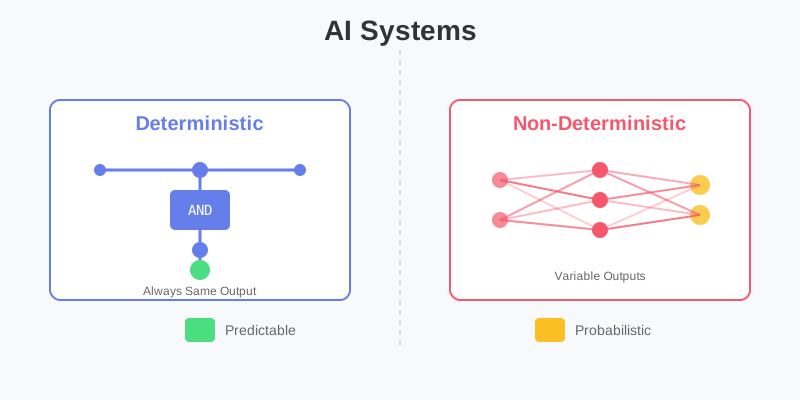
Deterministic vs Non-Deterministic AI: The Simple Guide
Here's a question: Why does your calculator always give you exactly "20" for a tip on a $100 bill, but when you ask ChatGPT to "write a funny joke about programmers," you get something different each time?
Welcome to the world of deterministic vs non-deterministic AI. Don't let the fancy words scare you—this is actually pretty simple (and kind of fun).
The Restaurant Menu Analogy
Imagine you're at two different restaurants:
Restaurant A (Deterministic):
- You order the "Chef's Special Burger"
- Every single time, you get the exact same burger
- Same ingredients, same presentation, same taste
- It's McDonald's. It's consistent. It's predictable.
Restaurant B (Non-Deterministic):
- You order the "Chef's Surprise"
- Each time, the chef makes something different based on their mood, available ingredients, and creativity
- Sometimes it's amazing, sometimes it's... interesting
- You never know exactly what you'll get!
That's the difference between these two types of AI.
Deterministic AI: The Reliable Friend
Deterministic AI is like that friend who always shows up on time and brings exactly what they promised.
Same input → Same output. Every. Single. Time.
// This is deterministic
function calculateTip(bill, percentage) {
  return bill * (percentage / 100);
}

calculateTip(100, 20); // Always returns 20
Where you see it:
- Your calculator (duh!)
- GPS navigation systems
- Banking software
- Medical devices
- Tax calculation tools
The Good Stuff:
- ✅ You can trust it completely
- ✅ Easy to test and debug
- ✅ Perfect for critical stuff (like your bank account)
The Meh:
- ❌ Can't adapt to new situations
- ❌ Requires programming every scenario
- ❌ Not very creative
Non-Deterministic AI: The Creative Wildcard
Non-Deterministic AI is like that artsy friend who's full of surprises. Sometimes genius, sometimes "what were you thinking?"
Same input → Different outputs. It's unpredictable by design.
The Big Secret About AI
Here's what most people don't understand about ChatGPT, DALL-E, and similar tools:
They're not actually thinking. They're pattern matching.
Imagine a super-powered autocomplete that's read the entire internet. It doesn't "know" that 2+2=4. It's seen millions of examples where people wrote "2+2=4", so it predicts that's what should come next.
Most of the time? It works beautifully.
But sometimes? It confidently tells you something completely wrong.
Where you see it:
- ChatGPT and Claude
- DALL-E and Midjourney
- Netflix recommendations
- Spotify's Discover Weekly
- GitHub Copilot
The Good Stuff:
- ✅ Handles complex, creative tasks
- ✅ Adapts to new situations
- ✅ Can surprise you with brilliant solutions
- ✅ Super fast at pattern recognition
The Not-So-Good:
- ❌ Can make confident mistakes
- ❌ Hard to predict behavior
- ❌ Shouldn't be trusted for critical decisions
- ❌ May give different answers to the same question
The "Smart" System That Guesses
Let me paint you a picture. Imagine you ask a system: "What's the capital of France?"
Traditional program (Deterministic):
- Looks up France in database → Returns "Paris"
- Every time. No thinking. Just lookup.
AI-powered system (Non-Deterministic):
- Scans millions of documents it's seen
- Finds patterns like "France... Paris", "French capital... Paris", "Paris, France"
- Generates the most likely answer based on patterns
- Usually says "Paris" but might say "Paris, France" or "The capital of France is Paris" or even add extra context you didn't ask for
Now imagine someone asks: "Write me a poem about coding."
What happens?
- Ask once: "Code flows like a river, bugs make me shiver..."
- Ask again: "In lines of logic, we find our way..."
- Ask a third time: Something completely different again
This is literally how LLMs work. They're incredibly sophisticated pattern matchers that generate responses, not databases that retrieve answers.
Mind-blowing, right?
When to Use Which?
Think of it this way:
Use Deterministic AI when:
- 💰 Money is involved (banking, payments)
- 🏥 Lives are at stake (medical devices, aviation)
- ⚖️ Legal compliance matters
- 🎯 You need 100% accuracy
- 🔒 You need to explain every decision
Use Non-Deterministic AI when:
- 🎨 You need creativity
- 💬 You're building conversational interfaces
- 📝 You're generating content
- 🔍 You're exploring ideas
- ⚡ Speed matters more than perfection
The Real-World Test
Let's say you need a calculator app:
For your banking app? Deterministic, no question. Even 0.01% error rate is unacceptable.
For splitting a restaurant bill with friends? Maybe non-deterministic AI could work—you're just looking for a ballpark figure anyway.
For your tax returns? Are you kidding? Deterministic all the way!
How to Use AI Safely
If you're going to use non-deterministic AI (and you should—it's amazing!), here's the golden rule:
Never trust it blindly.
Think of it like your super-smart but occasionally unreliable friend:
- ✅ Great for brainstorming
- ✅ Excellent for first drafts
- ✅ Wonderful for creative inspiration
- ❌ Don't let it make critical decisions alone
- ❌ Always verify important information
- ❌ Keep a human in the loop
Quick Safety Checklist:
- Validate outputs - Double-check important stuff
- Use guardrails - Set rules for what AI can and can't do
- Keep humans involved - Especially for big decisions
- Know the stakes - Higher risk = need more reliability
- Have a backup plan - What if the AI messes up?
The Future Is Hybrid
The smartest systems today use both:
- Start with fast AI for most tasks
- Add deterministic checks for critical stuff
- Fall back to reliable methods when needed
- Keep humans in charge of big decisions
It's like having both friends on your team: the reliable one AND the creative wildcard.
The Bottom Line
Deterministic AI = Your calculator. Boring but dependable. Same answer every time.
Non-Deterministic AI = ChatGPT. Creative and powerful. Different answers, educated guesses.
Neither is "better"—they're tools for different jobs.
Want to process payments? Deterministic. Want to write a creative blog post? Non-deterministic (but have a human edit it!).
The secret is knowing which tool to use when. And now you do! 🎉
One Last Thing
Remember: Modern AI is incredibly impressive, but it's fundamentally a pattern-matching machine, not a thinking machine. It doesn't "understand" anything—it's really good at predicting what should come next based on patterns it's seen.
Use it wisely. Verify the important stuff. And never, ever let it do your taxes.
Have you had any funny or surprising experiences with AI? I'd love to hear about them! Connect with me on LinkedIn and let's chat.
